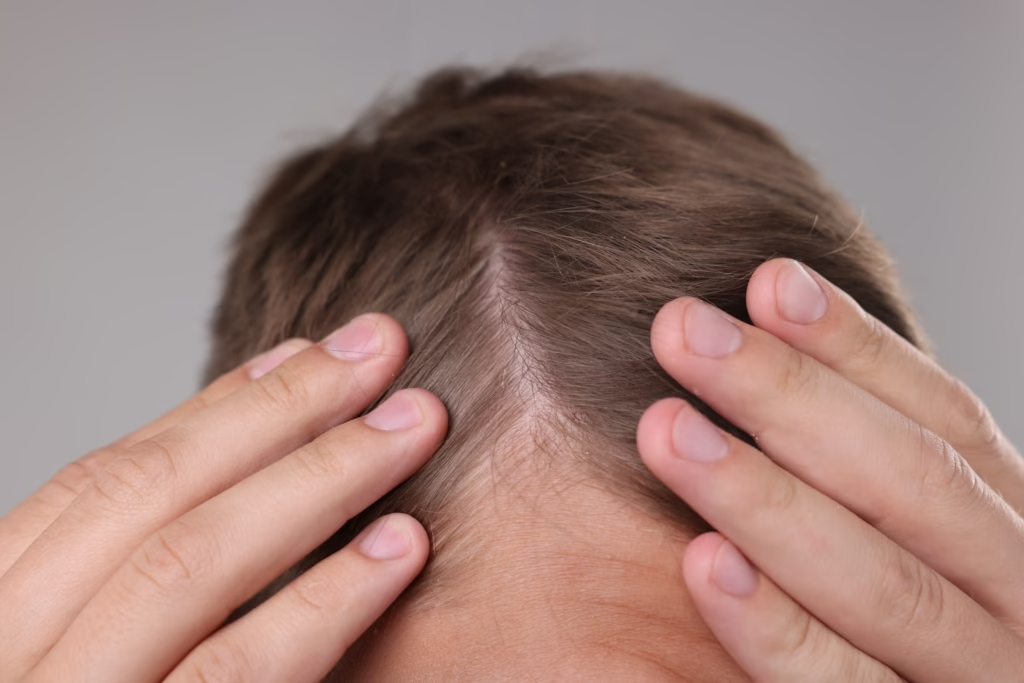
Most people protect their face daily and never think about the skin above it. Yet the scalp sits closest to the sun, receives UV at close to maximum intensity, and for anyone with thinning hair, a widening part, or a shaved head, it has almost no protection at all.
Decades of that exposure accumulate quietly, and the first anyone notices is often a rough patch that will not heal.
At Dr Refresh, scalp assessment is part of a full skin examination with specialist dermatologist Dr Ritu Gupta. Where sun damage has accumulated, options discussed at consultation may include prescription treatments, picosecond laser treatment for pigmentation, our Light, Bright and Brilliant package where redness and sun spots occur together, and Refresh 5 and Refresh 10 laser resurfacing for more extensive surface damage. Suitability is determined individually.
Why the Scalp Accumulates More Damage Than You Think
The scalp faces directly upward. At midday in Australia, that means it receives UV at close to the maximum intensity reaching the ground, while the face is partly shaded by the brow and nose.
How much protection hair provides depends almost entirely on density. Dense hair shields the skin beneath it reasonably well. The part line, the crown and a receding hairline are a different matter, and so is any area where hair has thinned, because protection falls away exactly where exposure is highest.
Men with male pattern hair loss and anyone with thinning hair are exposing skin that has spent decades covered and is now receiving UV at full intensity.
It is also the one area you cannot easily inspect. You see your face every morning. Most people have never looked at the top of their own head.
What Sun Damage on the Scalp Looks Like
- Solar lentigines: Flat brown patches, the same sun spots that appear on the hands and chest.
- Actinic keratoses: Rough, scaly or crusted patches that come and go and never fully resolve. They often feel abnormal before they look abnormal, so running a hand over the scalp can detect them when a mirror will not. These are precancerous changes. A proportion of individual lesions progress to skin cancer and their presence indicates sun damage across the surrounding area, which is why they are assessed rather than moisturised, and why treatment is often directed at the whole region rather than one spot.
- Persistent sores. A spot that bleeds, scabs, heals and then breaks down again is definitely worth examination.
Why Scalp Skin Cancer Deserves Particular Attention
Melanoma on the scalp carries a worse prognosis than melanoma elsewhere, with higher recurrence and mortality rates than other head and neck melanomas. Research from the Victorian Melanoma Service found invasive scalp melanoma was associated with male sex, increasing age and the presence of solar damage.
A separate Melbourne study of 3,570 cases found melanoma on the posterior scalp carried more than double the risk of poor survival compared with the upper back.
The common assumption is that hair conceals these lesions. The evidence suggests otherwise. In a study across Australian and Italian centres, most scalp melanomas arose on easily visible areas: 49% on hairless scalp and 15% at the hairline. The researchers concluded that proactive screening of the scalp should be encouraged.
One finding stands out. Lesions found by a doctor were thinner than those first noticed by the patient, a relative, or a hairdresser. The problem is not that the scalp is hidden. It is that nobody is looking at it systematically.
Dr Ritu has discussed melanoma detection on ABC Radio Sydney and in The Australian, and has spoken about the resurgence of deliberate tanning in The Australian, The Sun-Herald and The Age.
What Can Be Treated
Assessment comes first. A full skin examination includes the scalp, parted systematically and examined with a dermatoscope. Anything suspicious is assessed on its own merits, and skin cancer is managed medically or surgically rather than with cosmetic treatment.
Our guide to when a mole may be cancerous covers the warning signs, and how often you should have a skin check explains how risk determines frequency.
Pigmentation and sun spots may respond to picosecond laser, which fragments pigment using very short pulses.
Rough actinic patches are managed in several ways depending on how many there are, how extensive the underlying field damage is, and your skin type. Discrete lesions are often treated with cryotherapy. Where damage is widespread across an area rather than confined to individual spots, field-directed treatments including topical therapy and photodynamic therapy are used. Laser resurfacing is one of the available options and is generally considered where field damage is extensive. Which approach suits you is a clinical decision and is made after examination.
All light and laser treatment carries risks including redness, swelling, blistering, crusting and pigment change, with higher pigmentation risk in deeper skin tones. Multiple sessions are usual and individual results vary.
Protection is not optional afterwards. A broad-brimmed hat does more than any product, and daily sunscreen should extend to the part line and any exposed scalp. Dr Ritu has also addressed the recent SPF rating controversy.
Frequently Asked Questions
Can I get skin cancer on my scalp if I have a full head of hair?
Yes. Hair reduces exposure but does not eliminate it, and the part line and hairline remain exposed. Most scalp melanomas in the research arose on visible, hair-free areas.
How do I check my own scalp?
Use two mirrors, or ask someone to part your hair systematically and look. Running a hand over the scalp can detect rough patches before they are visible. Hairdressers often notice changes first.
What does an actinic keratosis feel like?
Rough or like sandpaper, sometimes tender, often more noticeable by touch than by sight. They can flake, resolve, and return in the same place.
Have Your Scalp Checked Properly
The scalp is one of the few areas where the problem is not that changes are hard to treat, but that nobody looks until something has been there for years.
If you have noticed a rough patch, a spot that will not heal, or you simply want your scalp examined properly as part of a full skin check, Dr Ritu and her clinically trained team can help. Please make an enquiry online, WhatsApp us at 0493 766 096, or call (02) 8014 6505.