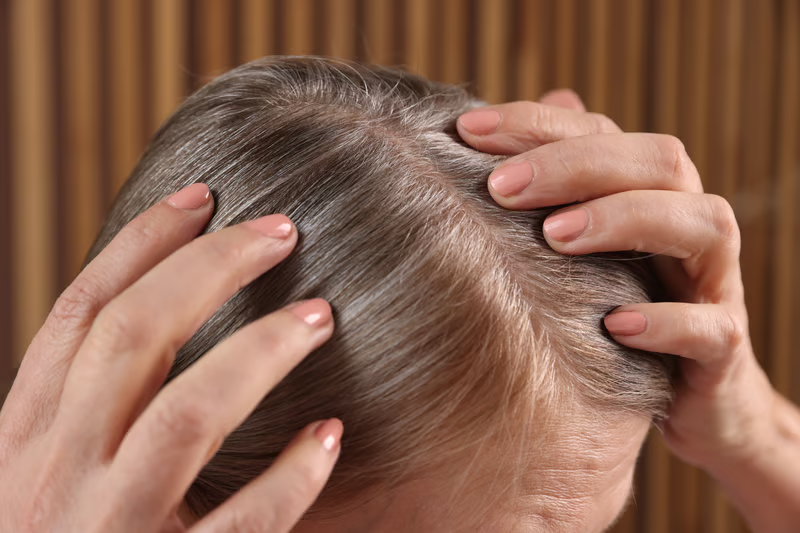
An itchy scalp is usually nothing serious. Dandruff, product build-up, sweat, a new shampoo: most causes are easily managed, and nothing is lost by waiting.
There is one pattern that is different, and it is worth knowing about, because the window to act on it closes.
At Dr Refresh, scalp symptoms occurring alongside hair loss are assessed as a diagnostic question first. Specialist dermatologist Dr Ritu Gupta examines the scalp with dermatoscopy, and may perform a scalp biopsy or arrange relevant blood tests before any hair loss treatment is considered, because the treatment depends entirely on which condition is present.
The Pattern That Matters
Itching, burning or tenderness of the scalp, occurring together with hair loss, can indicate a scarring alopecia.
In these conditions, inflammation destroys the hair follicle and replaces it with fibrous tissue. Once that has happened to a follicle, hair cannot grow from it again, and no treatment reverses it. The entire goal of treatment is to stop the inflammation before it reaches the follicles that are still working.
Symptoms are important. In most hair loss, delay costs you time. In this one, delay costs follicles permanently.
What to Look For
Alongside itching, burning or tenderness, the signs that warrant prompt assessment include:
- Redness or scaling around individual hair follicles
- Loss of the visible follicular openings, so an area of scalp looks smooth or shiny
- A hairline that recedes as a band rather than at the temples
- Loss of eyebrows alongside hairline change
- Hair loss in a patch that feels sore or sensitive to touch
- Hair loss beginning at the crown and spreading outward, particularly in women of African descent, which can indicate central centrifugal cicatricial alopecia
Lichen planopilaris and frontal fibrosing alopecia, which is considered a variant of lichen planopilaris, are among the more frequently seen scarring conditions. Frontal fibrosing alopecia affects postmenopausal women most often and is commonly mistaken for an ordinary receding hairline for years before it is assessed. By then, a band of follicles has usually been lost.
One caution. Not every scarring alopecia itches. Some are entirely painless, and frontal fibrosing alopecia in particular can progress without any symptoms at all. Symptoms raise the urgency; their absence does not rule the condition out. A hairline receding as a band, loss of eyebrows, or an area of scalp that has become smooth and shiny warrants assessment whether or not it is uncomfortable.
Dr Ritu has spoken in depth about hair loss assessment on ABC Radio and in The Sun-Herald and The Age.
What Else Causes an Itchy Scalp
Most causes are not scarring conditions, and it helps to know what else is in the differential.
- Seborrhoeic dermatitis. The most common cause. Flaking, redness and itch driven by an inflammatory response to yeast that lives normally on the skin. It is managed rather than cured, and it does not scar.
- Scalp psoriasis. Thicker, well-defined plaques with silvery scale, often extending past the hairline.
- Folliculitis. Inflammation of the follicles producing bumps and tenderness, covered in our guide to scalp and neckline folliculitis.
- Sweat and build-up. More common in summer, and the least concerning cause on this list.
- Contact dermatitis. A reaction to a hair product, dye or treatment, which often improves once the product is identified and stopped.
- Infection. Where skin is broken, signs of infection warrant prompt assessment.
- Several of these look similar to one another and to the early stages of a scarring condition, which is the practical difficulty.
Why This Needs Examination Rather Than Guesswork
A scarring alopecia and ordinary dandruff can both present as an itchy, flaking scalp with some hair coming out.
What separates them may not be visible to the naked eye. A specialist dermatologist can assess whether the follicular openings are preserved or lost, whether hairs are miniaturising, and whether inflammation is centred on the follicle. Where a scarring condition is suspected, a scalp biopsy is usually how the diagnosis is confirmed and the specific condition identified, since several scarring alopecias look similar on the surface and are managed differently.
Neither of those is something a photograph, a product recommendation, or an online quiz can substitute for. Our guide to the five types of hair loss explains how the conditions differ and why the diagnosis determines everything after it.
It is also worth knowing that trichology is not a registered health profession in Australia. Dermatology is the only medical specialty specialising in conditions of the skin, hair and nails, and a scalp biopsy or prescription treatment requires a medical doctor.
Frequently Asked Questions
Does an itchy scalp always mean hair loss?
No. Most itchy scalps have nothing to do with hair loss. The combination that warrants prompt assessment is itching, burning or tenderness occurring alongside hair thinning or loss.
Can hair grow back after a scarring alopecia?
Not from follicles that have already scarred. Treatment aims to stop the inflammation and protect the follicles that remain, which is why earlier assessment is important.
How long should I wait before getting it looked at?
If scalp symptoms are accompanied by hair loss, do not wait. If the itch is isolated and settles with a gentler shampoo, there is no urgency.
What happens at a hair and scalp assessment?
A history, examination of the scalp with magnification if required, and often blood tests. A biopsy is often needed where a scarring condition is suspected. The diagnosis determines what treatment, if any, is appropriate.
Get the Diagnosis Before the Treatment
With most hair loss, there is time to try things. With a scarring condition, there is not, and the sign that distinguishes it is one most people dismiss.
If you have scalp itching, burning or tenderness alongside hair loss, or a hairline that has started receding as a band, it is worth having assessed properly. Please make an enquiry online, WhatsApp us at 0493 766 096, or call (02) 8014 6505.