
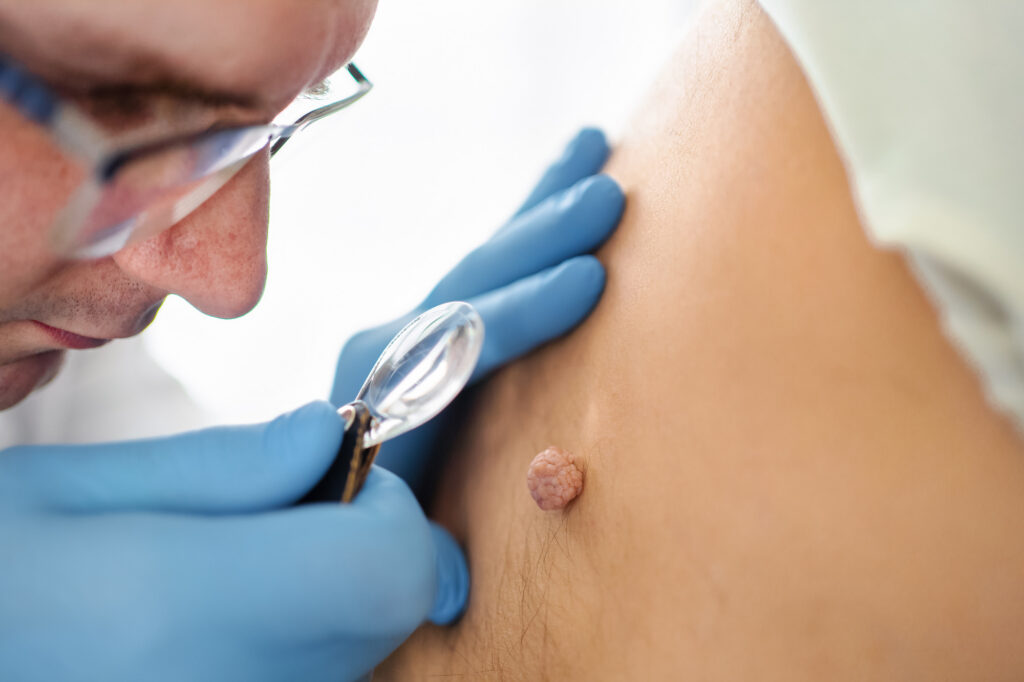
Australia has one of the highest UV rates in the world [1], and exposure to UV radiation from the sun is the major cause of skin cancer. Most Australians have multiple moles (nevi), and while most are completely harmless and stable, some are unlike the other; changing shape, size, and colour over weeks or months.
These changes can be disturbing, with many asking when a normal spot or mole turns into something sinister. When do you need a dermatologist to check your moles?
A calm, educated approach is needed to better understand your skin moles. We will touch on the mole evolution timeline and see why a “wait and see” approach is often the most dangerous way to handle changing moles. With the help of specialist dermatologist, Dr Ritu and her clinical staff, you can better understand your skin and how to care for it during these changes.
The Mutation Timeline: How and When Do Moles Turn Bad?
The Science
Melanoma is a deadly form of skin cancer that starts in the melanocytes, the cells that make the pigment melanin, which gives skin its colour. Melanoma usually develops on the skin that’s often exposed to the sun [2]. It may appear suddenly as a new spot or develop on an existing or previously benign mole, driven by genetic mutations caused by accumulated UV exposure.
Cumulative sun exposure and suffering from severe sunburns greatly increase the risk of developing melanoma. This is also a risk factor for basal cell carcinoma and squamous cell carcinoma, two other forms of skin cancer [3].
The “When”
From mole to melanoma, this is how this dangerous form of cancer progresses:
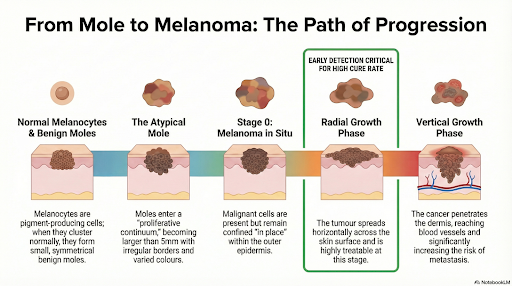
Normal Melanocytes and Benign Moles
Melanocytes are cells that produce the pigment melanin. When these clusters form in a normal pattern, they form symmetrical, harmless moles.
The Atypical Mole
At this phase, moles enter a growth stage, becoming larger than 5mm and developing irregular borders and different colours.
Stage 0: Melanoma in Situ
During this stage, malignant cells are present but remain confined to the outer epidermis.
Radial Growth Stage
The growth spreads horizontally across the skin. At this stage, the growth is highly treatable due to early detection.
Vertical Growth Stage
The cancer spreads to the dermis, entering blood vessels and greatly increasing the likelihood of metastasis or spread across adjacent tissues.
Note that these cellular changes don’t happen overnight but can progress rapidly within a few weeks or months. Therefore, it is critical to establish a baseline through a thorough skin check and regular monitoring to detect when a mole becomes cancerous.
The ABCDE Rule: Spotting the Exact Moment of Change
A skin check is critical for spotting the exact moment when a mole or a normal spot changes into something concerning. It starts at home, in the bath, or while dressing; you may ask a partner to check hard-to-reach areas such as your scalp, neck, and back.
The ABCDE Rule [4] is a useful tool to conduct a skin check at home. Check for:
A – Asymmetry
Watch out for moles that have become asymmetrical, or when one half of the mole suddenly looks different from the other.
B – Border
Moles have distinct borders, but when a once-smooth edge becomes irregular, ragged, or blurred, the mole may have started to spread.
C – Colour
Check for any changes in colour. For instance, a solid brown mole turns red, white, blue, or black after being observed for weeks.
D – Diameter
If the spot grows larger than 6mm or about the size of a pencil eraser, it could mean the cancer has grown radially and vertically.
E – Evolving
This is the ultimate “when” in the evolution of moles. Any noticeable changes in size, shape, colour, or elevation over only a short period are the best time to get professional help.
Physical Symptoms: When a Mole Starts Acting Strangely
Regular moles are asymptomatic; usually, you don’t even know that they are there. The physical symptoms below usually occur very late so it is important to be mindful and see warning signs before physical symptoms occur. But when these regular spots start acting up, it’s time to seek help from a professional.
Watch out for these physical symptoms:
- Intense itching – when a mole becomes itchy, disturbing your sleep and everyday activities.
- Oozing pus – when pus appears to come out of a mole.
- Crust development – crust or hardened skin areas appear over the mole.
- Bleeding – if moles start to bleed even without injury or scratching.
These are signs of abnormal cellular growth and should never be overlooked.
The “Ugly Duckling” Sign: When One Spot Stands Out
A hallmark self-diagnosis tool for melanoma is watching out for moles or marks that have completely evolved into a sinister, ugly mark: the “ugly duckling” sign.
For instance, if you have seven moles on your upper back, all of which have almost the same shape and size, but a new one suddenly appears, or an old one starts to change, looking completely different from the rest, this is an “ugly duckling” sign. A sure-fire sign that something’s wrong and needs an immediate professional check.
Stop Guessing: When to Book a Professional Skin Check at Dr Refresh
Conducting a self-skin check has its limitations; even if you find a suspicious mole, you cannot self-diagnose for skin cancer. Also, watching and waiting will only increase your risk of catching melanoma too late
At Dr Refresh, we use advanced tools, such as digital dermoscopy, to conduct a skin check of the deeper layers. This tool allows us to identify cancerous changes more accurately, even before these become visible to the naked eye.
Our comprehensive, full-body skin checks will help detect precancerous moles early and of course, treat them early as well. We remove moles using minimally invasive procedures, giving you utmost peace of mind.
Frequently Asked Questions
How fast does a normal mole turn into melanoma?
The timeline varies. Nodular melanoma grows fast and can become dangerous in just a few weeks. Meanwhile, other types may grow slowly over months or years. This is why any noticeable change must be checked immediately.
When should I worry about a raised mole?
Many healthy, benign moles become raised and soft as we age. A basic rule of thumb is if you know notice a change, it should be assessed. We do not expect any new moles or change in a preexisting mole after about the age of 25.
Should I get a mole removed to prevent skin cancer?
Removing healthy moles is not a standard medical procedure. But if a professional skin check identifies a suspicious or rapidly changing mole, your doctor may perform a biopsy to remove and test it.
When is the best time to start getting annual skin checks?
If you live in Australia, have fair skin, have a high mole count, and a family history of skin cancer, you should start getting annual professional skin checks in your early twenties or immediately after you notice a changing mole.
Remember that the only specialist in skin, hair and nails is a dermatologist and an easy way to check if you are seeing an actual skin cancer specialist, is to look for the letters, FACD after their name. This means they are a Fellow of the Australasian College of Dermatologists like Dr Ritu Gupta.
Detect Skin Cancer Early. Book A Skin Check Today
Timing is everything when it comes to skin cancer. Early detection is still the best treatment, turning a potentially fatal diagnosis into a simple in-clinic removal procedure.
Don’t play a guessing game with your health. If you are wondering when to get that changing mole checked, the answer is always now. Prioritise your peace of mind and book a comprehensive professional skin check with Dr Refresh today.
References
[1] Cancer Council – UV Index
[2] Mayo Clinic – Melanoma
[3] AIM at Melanoma Foundation – Sun exposure
[4] Cleveland Clinic – ABCDEs of Skin Cancer